
"Macbeth" and the Lady's End
Rushing to closure at the expense of justice

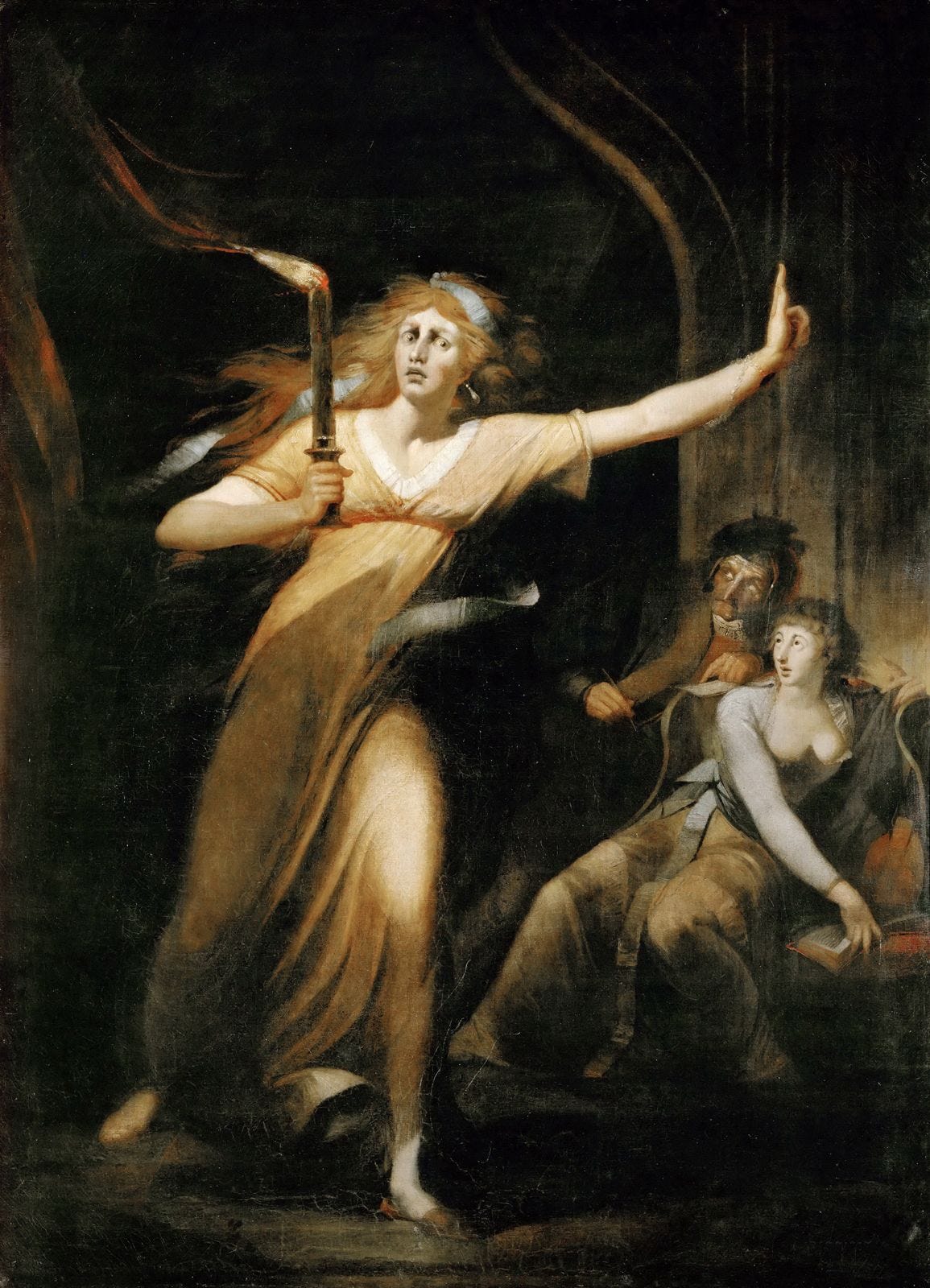
After Lady Macbeth loses her mind at the end of the play, the idea that she kills herself—perhaps in a flurry of guilt and mental decline—settles as a distinct likelihood.
The question of whether or not Lady Macbeth killed herself is usually settled in favor of suicide on the strength of three pieces of evidence: Malcolm’s testimony at the end of the play, the report by Seyton, and the audience’s psychological assessment of her character. She seems like the sort of person who would kill herself.
This interpretation is so dominant, so seemingly uncontroversial, that proposing an alternative explanation can feel forced. Some productions have her hang herself with a bedsheet. Others show her leaping from a balcony into icy water below. But a few have dared to suggest something different: that she dies in childbirth, or is even murdered. Are they wrong? How open to interpretation is her death, really?
Let’s start with Lady Macbeth’s mental state before she dies. When last we see her, she is sleepwalking through the castle, confounding doctors and maidservants as she wanders the halls, muttering, performing small ritual gestures with her hands.
She says during one of her nocturnal ambulations:
Out, damned spot! out, I say!—One: two: why,
then, ‘tis time to do’t.—Hell is murky!—Fie, my
lord, fie! a soldier, and afeard? What need we
fear who knows it, when none can call our power to
account?—Yet who would have thought the old man
to have had so much blood in him.
There’s something telling about her surprise that Duncan, in virtue of being old, would still have “so much blood.” It suggests her belief that age somehow lessens vitality, that older bodies are already half prepared for death. But as for her own life, the “spot” she cannot remove—her moral contamination—can only be purged through death. That reading has always appealed to audiences: Lady Macbeth, destroyed by guilt, takes her own life.
Yet Shakespeare refuses to give us that comfort so easily. He’s a master of tempting us toward closure, of letting us crave clarity that the text itself withholds.
Consider her body. The audience never sees it. For a play that shows Macbeth’s death so violently and visibly, his wife’s death happens offstage, invisible. The contrast is striking. As occurs often in the play, the male is displayed, the female obscured. One might even extend this idea to the vanishing of the witches, women who also disappear from the stage as the play closes.
When Macbeth receives the news of his wife’s death, he doesn’t even ask how it happened. He simply accepts it.
She should have died hereafter;
There would have been a time for such a word.
To-morrow, and to-morrow, and to-morrow,
Creeps in this petty pace from day to day…
What a strange thing to say upon hearing your wife has died.
Macbeth’s reaction can be read two ways. Perhaps he’s unsurprised she killed herself, having watched her mind unravel. Or perhaps he’s too numb to care. Death has surrounded him for so long that its causes no longer matter. Either way, he’s detached—philosophically, maybe even cosmically—from the personal tragedy before him. The pair who unleashed chaos upon Scotland are now undone by it, and Macbeth’s indifference tempts us, too, to stop caring. We, like him, are ready to move on, to wash away the “spot” that is both of them.
But should we?
Some scholars suggest that Shakespeare simply followed stage conventions. Suicide, especially a woman’s suicide, might have been considered indecorous to portray. Perhaps the offstage report was a practical necessity.
Yet that argument doesn’t hold up. Shakespeare never shied away from dramatizing suicide elsewhere. “Romeo and Juliet” ends with two of them vividly shown. “Julius Caesar,” “Othello,” “Antony and Cleopatra,” all feature self-inflicted deaths onstage. The idea that he was too prudish to show Lady Macbeth’s is nonsense.
So what does the omission mean?
It may be that Shakespeare withholds the manner of Lady Macbeth’s death not out of squeamishness but out of design. He wants the audience to feel the pull of closure, to project their need for justice onto the story’s end. We want her dead. We want balance restored. And so we accept whatever explanation the text gives us, no matter how thin.
When a director chooses how to stage Lady Macbeth’s death, they are, in a sense, choosing what kind of play they believe Macbeth is. If she kills herself, the play becomes moral: guilt leads to madness, madness to self-destruction. If she’s murdered, the play becomes political: power consumes even the innocent.
If it were me, I’d leave it ambiguous, as Shakespeare does.
That decision says something about us, the audience. How certain do we need to be? How eager are we to trust the testimony of Malcolm, a character who, after all, has every political reason to narrate events in a way that legitimizes his rule? In a play where betrayal runs rampant, why should we suddenly trust him?
Perhaps because, by the end, we’re desperate to trust someone. After so much deceit, we cling to the first voice that sounds authoritative. We want to believe Malcolm. We want to close the play.
But justice isn’t about speed; it’s about truth. Macbeth’s death is witnessed. Lady Macbeth’s is not. His murder is undeniable. Hers remains unresolved.
By refusing to show us her death, Shakespeare leaves her fate entangled with the audience’s own imagination. We become complicit in the interpretation. Whether she jumps, hangs, bleeds, or simply disappears, what we believe says as much about us as it does about her.
I love your essay about my favorite of Shakespeare's tragedies. I always assumed that the cause of her death was suicide, but now I wonder. Hamlet's Ophelia comes to an even more ambiguous end.
I loved the production of the Scottish Play at the Denver Center for the Performing Arts, with all roles played by men (i.e., the Lady with a hairy chest).
https://www.cpr.org/2017/09/22/what-a-renovated-space-theatre-means-for-denver-centers-unconventional-macbeth/
I've never given a second thought to the cause of her death; for me suicide has always been a given. But this is a very interesting take. I also took it as a given that Malcolm is a saint that deserves our trust, but maybe I just sympathise with him because he lost his father to murder. So many assumptions. Need to brood upon this.